
Facial aging is not only about the surface of your skin. Changes in collagen, soft tissue, and the muscles that help support facial expression and contour can all affect how your face looks over time.
EMFACE combines synchronized radiofrequency with HIFES® facial muscle stimulation to work on the skin and selected facial muscles during the same noninvasive procedure.
Thrive Medicine Clinic offers EMFACE in Houston Heights for clients looking for a needle-free approach to facial rejuvenation, wrinkles, and changes in facial contour without surgery.
What Is EMFACE?
EMFACE is a noninvasive facial technology that combines synchronized radiofrequency with HIFES facial muscle stimulation.
The radiofrequency component delivers controlled heating to facial tissue, while HIFES produces repeated contractions in selected facial muscles. The two technologies are delivered together during the session.
Unlike RF microneedling, EMFACE does not use needles.
Unlike injectable neuromodulators, EMFACE does not work by temporarily blocking nerve signals to selected muscles.
Unlike dermal filler, EMFACE does not add injectable material to create volume.
It represents a different approach to facial rejuvenation by working with both facial tissue and muscle activity.
EMFACE is FDA-cleared for noninvasive temporary reduction of facial wrinkles and applies muscle stimulation resulting in an induced muscle workout.

Your Face Is More Than Skin
Many facial procedures focus on one component of facial aging.
A resurfacing procedure may focus primarily on skin.
A filler may add volume.
A neuromodulator affects selected muscle activity.
EMFACE approaches the face differently by combining radiofrequency with active stimulation of selected facial muscles.
EMFACE does not address every one of these structures, nor should it be presented as a replacement for every other facial procedure. Its distinguishing feature is that it combines a skin-focused radiofrequency component with facial muscle stimulation during the same noninvasive session.
How Does EMFACE Work?
EMFACE combines two technologies at the same time.
Synchronized Radiofrequency
Radiofrequency delivers controlled thermal energy to targeted facial tissue.
BTL describes this component as supporting collagen and elastin-related remodeling within the skin.
HIFES Facial Muscle Stimulation
HIFES stands for High-Intensity Facial Electrical Stimulation.
The technology causes selected facial muscles to contract repeatedly while the applicators are in place.
Clinical studies have evaluated changes in muscle characteristics following combined synchronized RF and HIFES procedures.
A 2025 prospective study involving 37 participants found measurable changes in facial muscle characteristics, skin displacement, and facial volume following four synchronized RF and HIFES sessions.
Another 2025 pilot study found measurable changes consistent with improved resting muscle quality following four sessions.
These studies help explain the mechanism behind EMFACE. They do not guarantee that every client will experience the same degree of change.
What Do Facial Muscles Have to Do With How Your Face Looks?
Facial muscles influence expression, position, movement, and the support of overlying tissues. Changes in the face over time do not come from a single source. Skin quality changes, fat can redistribute, skeletal anatomy changes, and muscles may also change. This is one reason facial rejuvenation should not automatically mean adding volume or tightening only the skin. Research on synchronized RF and HIFES has evaluated the technology’s effects on muscles including the frontalis and zygomaticus regions and has documented measurable changes in muscle-related parameters. The appropriate procedure still depends on what is creating the appearance that concerns you.
What Concerns Lead People to Consider EMFACE?
People commonly investigate EMFACE when they begin noticing changes such as:
The appropriate use depends on your anatomy, goals, health history, and the EMFACE applicators available at Thrive Medicine Clinic. EMFACE should not be presented as capable of correcting every facial concern. For example, pigmentation, significant acne scarring, deeper structural laxity, and substantial volume loss may require different approaches.
EMFACE for Facial Wrinkles
EMFACE is FDA-cleared for the noninvasive temporary reduction of facial wrinkles.
That clearance is important, but it does not mean every wrinkle has the same cause. Wrinkles may be influenced by:
● Repeated facial movement
● Skin quality
● Collagen changes
● Sun exposure
● Tissue position
● Volume loss
● Natural anatomy
EMFACE uses synchronized RF and muscle stimulation rather than injections.
Clinical research evaluating combined RF and HIFES has reported improvement in facial wrinkle measurements after a series of procedures.
A multicenter study of 24 participants documented progressive wrinkle improvement through the three-month follow-up period after four procedures.
A separate 2025 upper-face study involving 37 participants reported significant improvement in forehead and lateral eye-area wrinkles through its follow-up period.
Individual outcomes vary.
EMFACE for the Forehead and Brow Area
The upper face is one of the areas where muscle behavior, skin quality, and tissue position interact.
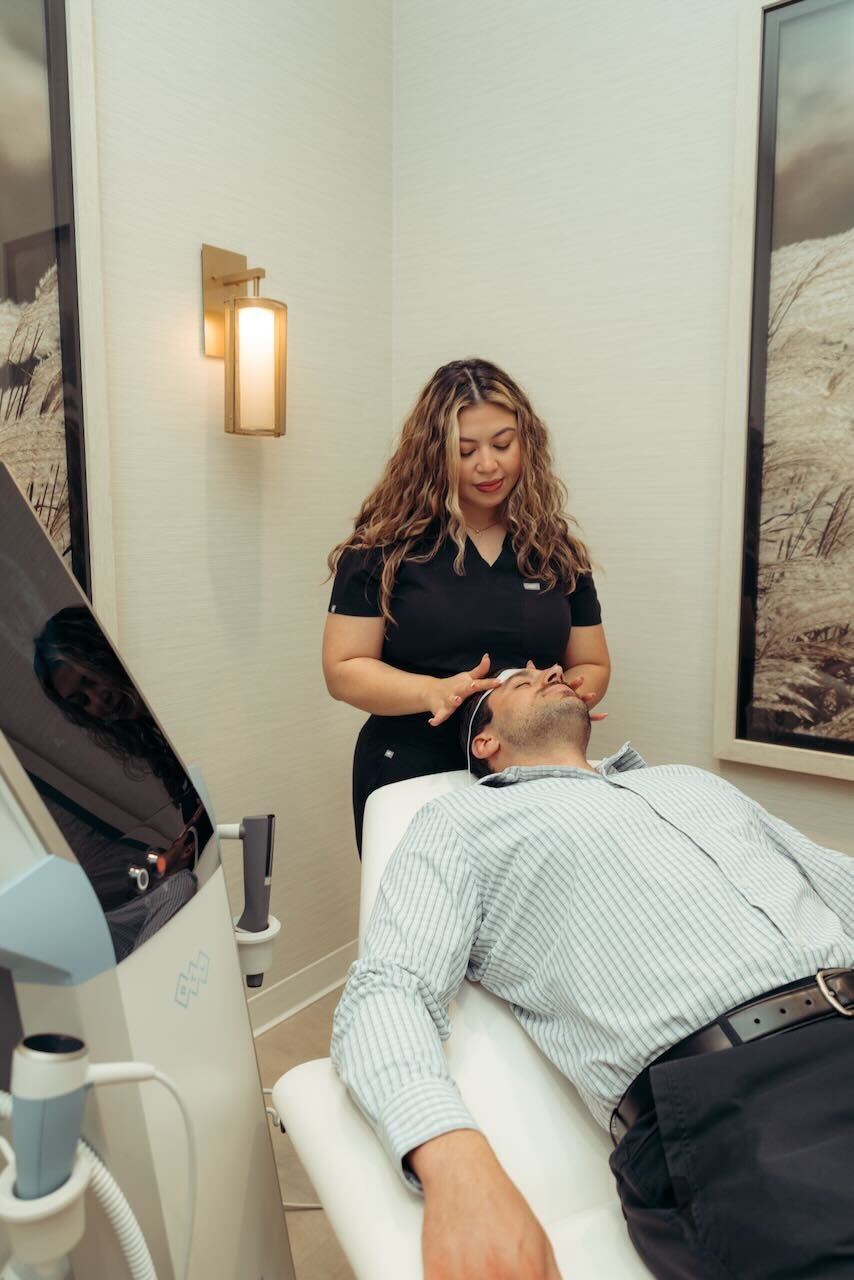
EMFACE applicators can stimulate selected muscles of the upper face while synchronized RF is delivered to the overlying tissue.
A 2025 prospective study of 37 participants receiving four synchronized RF and HIFES sessions reported improvement in forehead and lateral eye-area wrinkles along with measurable eyebrow-position changes through 24 weeks after the initial procedure.
Those results represent a study population, not a guaranteed amount of brow elevation for every client.
EMFACE also should not be described as providing the same correction as a surgical brow lift.
EMFACE for Cheek Definition and Midface Support
The midface changes with age in several ways.
Skin changes, soft tissue shifts, fat distribution changes, and facial muscle characteristics can all affect cheek contour and overall facial appearance.
EMFACE’s cheek applicators combine synchronized radiofrequency with HIFES stimulation of selected midfacial muscles.
A 2025 study evaluating synchronized RF and HIFES in the midface documented measurable changes in muscle thickness, tissue displacement, and facial volume after a four-session series.
A separate 2025 retrospective study of 43 participants reported changes in cheek and mandibular volume following four 20-minute sessions.
These findings help explain why EMFACE is used in facial-contour discussions. They should not be converted into guaranteed volume or lifting claims on Thrive’s website.
What Is EMFACE Eyes?
EMFACE Eye is a dedicated applicator designed for the eye area.
BTL currently identifies the Eye applicator as FDA-cleared for aesthetic use involving facial and neck stimulation or body skin stimulation.
People may investigate EMFACE Eye when they are concerned about the appearance of the area around or beneath the eyes but prefer a noninvasive, needle-free approach.
The eye area is anatomically complex.
Under-eye bags, skin laxity, pigmentation, hollowing, fluid retention, and structural changes can create similar-looking concerns for different reasons.
That is why an evaluation matters before assuming EMFACE Eye is appropriate.
What Is EMFACE Submentum?
EMFACE Submentum is designed for the area beneath the chin.
The manufacturer states that the Submentum applicator is FDA-cleared for aesthetic use and is further cleared to affect the appearance of lax tissue in the submental area.
Unlike the standard forehead and cheek application, the submental approach addresses concerns involving the area under the chin and jawline.
A 2025 MRI study involving 33 participants receiving four weekly HIFES plus synchronized RF+ procedures reported measurable reductions in submental volume and submental fat during follow-up.
Those study findings should not be presented as a guaranteed percentage of double-chin reduction for Thrive clients.
Does EMFACE Melt Facial Fat?
This question deserves a more careful answer than “yes” or “no.”
The standard EMFACE forehead and cheek procedure and the dedicated EMFACE Submentum application should not be treated as the same thing.
The current submentum technology is intentionally used in an area where reduction of submental volume can be part of the aesthetic goal. Clinical studies have documented submental fat changes with the dedicated HIFES and synchronized RF+ approach.
The standard facial application is used differently.
People concerned about preserving facial volume should discuss that concern directly with the provider before proceeding.
Thrive should not use blanket statements such as:
“EMFACE can never affect facial fat.”
Nor should it imply that all EMFACE facial applications are designed to reduce fat.
Applicator, treatment area, anatomy, and clinical goal matter.
Not Sure Which Facial Concern You Are Actually Seeing?
You do not need to diagnose whether the change is coming from skin, muscle, volume, or another part of your facial anatomy before contacting Thrive Medicine Clinic.
Start with what you notice and what you would like to improve.
Our team can discuss whether EMFACE is worth considering and how it differs from the other facial technologies available at Thrive.
What Does an EMFACE Session Feel Like?
During a standard EMFACE session, applicators are positioned on the selected areas of the face.
You can expect two sensations:
1- Warmth from the synchronized radiofrequency
2- Repeated contractions from the HIFES muscle stimulation.
BTL describes the experience as a combination of gentle muscle contractions and warming. The manufacturer notes that comfortable heat may occur, but unpleasant burning or pain should not be considered normal.
The intensity is adjusted according to the procedure and individual tolerance.
No needles are involved in the standard EMFACE facial procedure.
How Long Is an EMFACE Session?
BTL’s standard EMFACE protocol uses approximately 20-minute sessions.
The actual time you spend at Thrive may be longer because your visit can include preparation, discussion, photography, device placement, or other clinic-specific steps.
How Many EMFACE Sessions Do You Need?
BTL’s standard aesthetic protocol consists of four 20-minute sessions, typically spaced about one week apart.
Clinical studies have also commonly evaluated a four-session series.
That does not mean every client needs exactly the same schedule. Your provider may modify the plan based on:
When Will I See EMFACE Results?
EMFACE should not be positioned as an instant surgical-style transformation.
BTL states that some people notice changes earlier, while visible improvement commonly develops after the treatment series.
Clinical research helps explain why later evaluation matters.
Studies of synchronized RF and HIFES have measured changes at one month, three months, six months, or other follow-up intervals rather than judging results only immediately after a session.
Your timeline can depend on:
Results vary from person to person.
How Long Do EMFACE Results Last?
There is no universal duration that Thrive should promise every client.
Facial aging continues after the procedure.
Skin changes, muscle characteristics, sun exposure, lifestyle, health, and natural anatomy all continue to influence facial appearance.
Some clinics advertise a specific duration or fixed maintenance interval, but that should not automatically become Thrive’s recommendation.
The better approach is to assess the client’s response and discuss maintenance based on actual goals and changes over time.
Does EMFACE Have Downtime?
The standard EMFACE procedure is noninvasive and BTL states that clients can generally resume their normal daily activities immediately afterward.
That makes EMFACE different from procedures that intentionally create wounds, needle channels, or surface resurfacing.
However, “no downtime” should not be interpreted as “no possible side effects.”
BTL’s current safety information notes that temporary skin effects including crusting, blistering, or burns are possible adverse effects of the device.
If you experience unexpected discomfort or a skin reaction, contact the treating clinic.
EMFACE vs Botox: How Are They Different?
EMFACE and Botox-type neuromodulators work through very different mechanisms.
EMFACE
Uses synchronized RF plus HIFES facial muscle stimulation.
Neuromodulators
Temporarily reduce signaling to selected muscles to decrease specific muscle activity.
This makes the question “Is EMFACE better than Botox?” too simplistic.
Someone concerned about a specific dynamic expression line may be asking a different question from someone interested in broader facial muscle support and skin-related changes.
The two approaches may also be used within the same person’s aesthetic plan when medically appropriate.
Thrive should explain the difference rather than declaring one technology the winner.
EMFACE vs Dermal Filler
Dermal fillers add material beneath or within tissue to create volume, contour, or support.
EMFACE does not inject filler.
Its facial application uses synchronized RF and HIFES muscle stimulation.
This distinction can matter for someone who wants a needle-free approach or does not necessarily want additional injected volume.
But EMFACE should not be marketed as a direct filler replacement.
A person with meaningful volume loss may have different needs from someone whose primary concern is facial muscle support, wrinkles, or early contour changes.
What’s the Difference Between EMFACE and EXION?
Thrive Medicine Clinic offers both technologies, which can make the distinction confusing.
EMFACE
EMFACE is distinguished by its facial muscle stimulation.
EMFACE does not use microneedles and specifically includes HIFES facial muscle stimulation.
Explore EMFACE →EXION
EXION is a broader platform with different applications for skin and tissue concerns.
EXION Fractional RF, for example, uses RF microneedling and may be more relevant when concerns include acne scars, enlarged-looking pores, or uneven texture.
Explore EXION →If you’re deciding between the two, begin with what you actually want to improve.
Can EMFACE Replace a Facelift?
EMFACE should not be presented as a replacement for facial surgery.
Surgery can reposition and remove tissue in ways a noninvasive energy-based procedure cannot.
EMFACE is intended for people looking for a noninvasive approach to facial wrinkles, muscle stimulation, and facial appearance.
Someone with significant tissue laxity who expects a surgical degree of correction may not be satisfied with a noninvasive device.
A good consultation should clarify that difference before treatment.
Avoid terms such as:
● Liquid facelift
● Facelift without surgery
● Instant facelift
● Surgical results without surgery
unless used purely to explain why those comparisons are misleading.
Who Is a Potential Candidate for EMFACE?
EMFACE may be worth discussing if you:
But not everyone is an appropriate candidate.
Device choice should account for medical history, implanted devices, treatment area, current aesthetic procedures, and individual anatomy.
When Might EMFACE Not Be Appropriate?
BTL states that EMFACE should not be applied over certain electronic or metal implants or over some areas of scar tissue or hair.
Other health or device-related considerations may also affect candidacy. Tell your provider about:
● Pacemakers or implanted electronic devices
● Metal implants
● Facial implants
● Active skin concerns in the area
● Current medications
● Pregnancy or possible pregnancy
● Recent aesthetic procedures
● Any relevant medical condition
Can You Have EMFACE if You Already Have Botox or Filler?
Having previous injectable procedures does not automatically answer whether EMFACE is appropriate.
The timing, location, type of injectable, amount used, and treatment goals can all matter. Tell the Thrive Medicine Clinic team:
EMFACE at Thrive Medicine Clinic in Houston Heights
Thrive Medicine Clinic is a physician-led medical practice located at 802 W 18th St in Houston Heights. The clinic’s broader focus includes metabolic health, longevity, body composition, wellness, and advanced aesthetic technologies.
That broader medical setting creates an opportunity to approach facial technology differently.
The question does not need to be:
“How do we sell an EMFACE package?”
The better question is:
“What is actually contributing to the facial concern this client wants to address?”
Someone bothered by acne scars may be better served by a skin-focused technology.
Someone seeking a very specific expression-line change may want to discuss another option.
Someone interested in facial muscle stimulation and a needle-free procedure may find EMFACE worth exploring.
Thrive’s BTL technology collection allows the consultation to begin with the client’s concern instead of trying to make one device solve every problem.
EMFACE in Houston Heights
Thrive Medicine Clinic is located in Houston Heights at:
802 W 18th St
Houston, TX 77008
Phone:
(281) 801-8662
The clinic serves clients from Houston Heights and surrounding Houston communities who are looking for medically guided wellness and aesthetic services.
If you’re researching EMFACE in Houston, your consultation can help you understand how this technology differs from other facial options and whether its muscle-and-skin approach makes sense for what you want to improve.
Frequently Asked Questions About EMFACE
What is EMFACE?
EMFACE is a noninvasive technology that combines synchronized radiofrequency with
HIFES facial muscle stimulation. It is designed to address facial tissue and selected facial muscles during the same procedure.
Is EMFACE FDA cleared?
EMFACE is FDA-cleared for noninvasive temporary reduction of facial wrinkles and applies muscle stimulation resulting
in an induced muscle workout. Additional EMFACE applicators have their own clearances and intended uses.
Does EMFACE use needles?
No. The standard EMFACE facial procedure uses external applicators and does not require microneedles or injections.
How long does an EMFACE session take?
BTL’s standard protocol uses approximately 20-minute sessions. Your total appointment time at Thrive may be longer depending on preparation and consultation.
How many EMFACE sessions do I need?
BTL’s standard protocol consists of four sessions, typically spaced about one week apart. Individual plans can vary, so Thrive should confirm the appropriate schedule after evaluating your goals.
Is there downtime after EMFACE?
The standard procedure is noninvasive and typically does not require a planned recovery period. BTL states that normal daily activities can generally resume immediately. Side effects are still possible, so “no downtime” should not be interpreted as “risk-free.”
Does EMFACE hurt?
The procedure generally produces warmth and repeated muscle contractions. BTL describes comfortable heat and muscle stimulation during treatment. Experiences can vary between individuals.
When will I see EMFACE results?
Some people notice changes during or shortly after the treatment series, while other changes can develop gradually. Clinical studies commonly evaluate outcomes at one, three, and six months following treatment rather than only immediately afterward.
How long do EMFACE results last?
There is no single duration that can be guaranteed. Facial aging and tissue changes continue over time. Your provider can discuss whether maintenance sessions make sense based on your response and goals.
Is EMFACE the same as Botox?
No. Neuromodulators temporarily reduce signaling to selected muscles. EMFACE uses synchronized RF and HIFES facial muscle stimulation. The mechanisms and goals are different.
Is EMFACE the same as filler?
No. Dermal fillers place injectable material into tissue to add volume or contour. EMFACE does not inject filler.
Can EMFACE replace filler?
Not necessarily. Someone with true volume loss may have different needs from someone seeking facial muscle stimulation and noninvasive rejuvenation.
Is EMFACE better than Botox or filler?
There is no universal winner because the procedures do different things. The appropriate option depends on the facial concern,
anatomy, goals, and desired type of procedure.
What is the difference between EMFACE and EXION?
EMFACE combines synchronized RF with facial muscle stimulation. EXION is a broader platform with skin and tissue applications, including EXION Fractional RF microneedling. If skin texture, acne scars, or pores are the main concern, EXION Fractional RF may be more directly relevant.
Can EMFACE help a double chin?
A dedicated EMFACE Submentum applicator is available and has FDA clearance relating to aesthetic stimulation and the appearance of lax submental tissue.
Does EMFACE work around the eyes?
A dedicated EMFACE Eye applicator is available for aesthetic use. Whether it is appropriate depends on what is actually causing the appearance around the eyes.
Who should not have EMFACE?
Certain implanted electronic or metal devices and other health circumstances may affect candidacy. A provider should review your medical and procedural history before treatment.
Will EMFACE make me look overdone?
EMFACE does not inject volume into the face. Changes develop through the effects of the energy and muscle-stimulation technologies. Results still vary, and the goal should be realistic improvement rather than a promise of a specific appearance.
Explore EMFACE in Houston Heights
If you’re interested in facial rejuvenation but are not necessarily looking for needles, injections, or surgery, EMFACE offers a different approach by combining synchronized radiofrequency with facial muscle stimulation.
The next step is determining whether that approach matches what you actually want to improve.
At Thrive Medicine Clinic in Houston Heights, we can discuss your facial concerns, explain how EMFACE differs from other available technologies, and determine whether it is an option worth considering.
Call Thrive Medicine Clinic: (281) 801-8662
Thrive Medicine Clinic
802 W 18th St
Houston, TX 77008