
Bladder leakage can begin after having a baby, become more noticeable years later, or appear for the first time during perimenopause or menopause.
You may leak when you cough, sneeze, run, jump, lift, or exercise. You may also notice more urgency, more frequent trips to the bathroom, or less confidence in your bladder control than you used to have.
Pregnancy, childbirth, aging, and menopause can all influence pelvic-floor and urinary function, but they do not affect every woman in the same way.
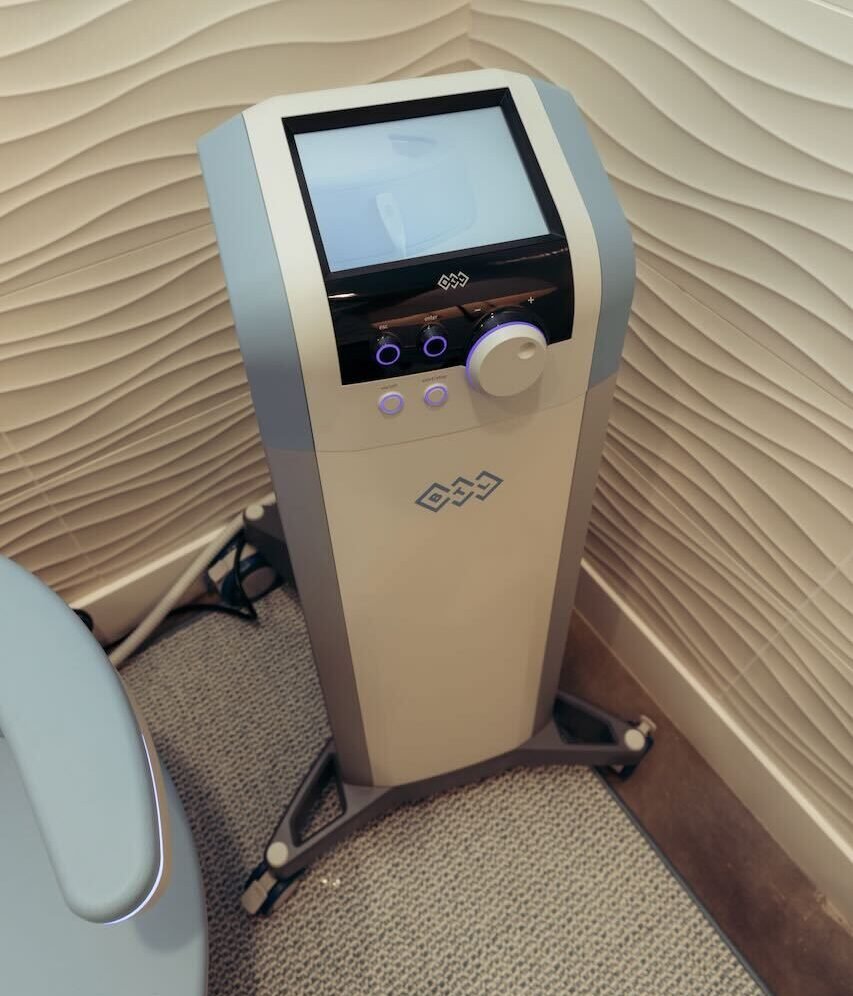
EMSELLA uses high-intensity focused electromagnetic technology to stimulate the pelvic-floor muscles while you remain seated and fully clothed.
Thrive Medicine Clinic offers EMSELLA in Houston Heights for women interested in a noninvasive approach to pelvic-floor rehabilitation and bladder-control concerns.
Can EMSELLA Help With Bladder Leakage After Childbirth or Menopause?
EMSELLA may be worth discussing when pelvic-floor weakness is contributing to urinary leakage.
Pregnancy and childbirth can weaken or strain the muscles and tissues involved in bladder support.
Menopause can also be associated with pelvic-floor and urinary changes, although declining estrogen can affect the bladder, urethra, and vaginal tissues in ways that muscle strengthening alone does not address.
EMSELLA uses HIFEM® electromagnetic energy to create repeated pelvic-floor muscle contractions without requiring you to perform each contraction voluntarily.
Research supports HIFEM as a promising option for selected women with urinary incontinence, including women who have given birth and postmenopausal women. However, candidacy depends on the type and cause of your symptoms.
Why Does Bladder Leakage Sometimes Start After Having a Baby?
Pregnancy and childbirth place significant demands on the pelvic floor.
The pelvic-floor muscles and connective tissues help support the bladder, urethra, uterus, and rectum.
During pregnancy, these tissues support increasing weight and pressure.
During vaginal delivery, the pelvic-floor muscles and surrounding tissues stretch to allow birth.
ACOG identifies pregnancy and vaginal childbirth as major contributors to pelvic support problems and pelvic-floor weakness.
After delivery, some women notice:
Not all of these symptoms mean the pelvic floor simply needs strengthening.
That distinction matters.
Leakage When Coughing, Sneezing, Running, or Jumping
One of the most common postpartum bladder complaints is stress urinary incontinence.
This is leakage that occurs when physical pressure increases on the bladder.
Examples include:
ACOG describes stress urinary incontinence as urine leakage during physical activity or actions such as coughing, laughing, or sneezing.
Pelvic-floor weakness can contribute because the muscles and tissues supporting the bladder and urethra are less able to respond to sudden increases in pressure.
When weakness is part of the problem, pelvic-floor strengthening may be useful.
EMSELLA provides another way to stimulate those muscles without requiring you to voluntarily produce every contraction.
What if I Have Pain, Tightness, or Difficulty Relaxing?
Postpartum pelvic-floor symptoms are not always caused by weak muscles.
Some women develop:
Houston pelvic-health practices commonly treat postpartum clients for both weakness and overactivity, including pain, scar restrictions, prolapse symptoms, and difficulty returning to exercise.
If your pelvic floor is overly tight or painful, repeatedly adding stronger contractions may not be the right first step.
EMSELLA is designed around rehabilitation of weak pelvic-floor muscles.
If pain, spasm, significant tightness, or difficulty relaxing is your primary symptom, pelvic-floor physical therapy or another pelvic-health evaluation may be more appropriate before additional strengthening.
Does Delivery Type Matter?
Yes, but it does not tell the entire story.
Vaginal delivery can directly stretch pelvic-floor muscles and supporting tissues.
A C-section avoids some of those delivery-related stresses, but pregnancy itself still changes pressure, posture, abdominal function, and pelvic support.
Women who have had either type of delivery can experience urinary leakage or other pelvic-floor symptoms.
Your delivery history is therefore useful information, but Thrive should not assume:
Vaginal birth = weak pelvic floor
or
C-section = no pelvic-floor problem.
The actual symptoms and pelvic function matter more.
How Soon After Childbirth Can I Start EMSELLA?
There should not be one universal postpartum start date on this website.
Recovery differs depending on:
ACOG describes postpartum care as an ongoing recovery process rather than a single appointment and specifically includes urinary incontinence among postpartum health concerns that may need attention.
EMSELLA should not be used during pregnancy.
After delivery, the appropriate timing should be determined after adequate healing and appropriate postpartum medical clearance.
Thrive should add its actual postpartum timing protocol once confirmed by the provider.
Can Breastfeeding Affect Pelvic or Vaginal Symptoms?
Breastfeeding can affect hormone levels.
ACOG notes that lower estrogen after childbirth, particularly while breastfeeding, can contribute to vaginal dryness and related tissue changes.
That matters because not every postpartum symptom is a muscle-strength problem.
A woman may have:
at the same time.
EMSELLA is designed to stimulate pelvic-floor muscles.
It does not directly replace estrogen or treat vaginal dryness caused by hormonal changes.
If dryness, burning, painful intercourse, or irritation are significant symptoms, those concerns should be discussed separately rather than assuming pelvic-floor strengthening will solve them.
Why Can Bladder Symptoms Change During Perimenopause and Menopause?
Menopause affects more than menstrual periods.
As estrogen levels decline, the tissues of the vagina, urethra, and bladder can change.
ACOG notes that lower estrogen can make vaginal tissue thinner, drier, and less elastic and can also affect the urinary tract. Urinary frequency and recurrent urinary-tract infections can become more common.
At the same time, aging can affect:
This means a woman developing leakage during menopause may have more than one contributing factor.
Pelvic-floor weakness may be part of the picture.
Hormonal tissue changes may be another.
Is Every Menopause-Related Bladder Symptom Caused by Weak Muscles?
No.
One important condition is genitourinary syndrome of menopause, often called GSM.
GSM results from declining estrogen and other sex hormones and can affect:
Symptoms may include:
ACOG and The Menopause Society both describe urinary symptoms as part of GSM.
EMSELLA strengthens pelvic-floor muscles through electromagnetic stimulation.
It does not replace estrogen or directly correct the vaginal and urinary-tissue changes caused by estrogen deficiency.
A woman experiencing dryness, burning, recurrent UTIs, or painful intercourse may need a different or additional discussion.
What if I Leak During Exercise, Coughing, or Sneezing?
Stress urinary incontinence can become more noticeable with age and during or after menopause.
NIDDK identifies menopause as one of the factors that can contribute to bladder-control problems in women and notes that weakened pelvic-floor muscles can make it harder to prevent leakage when pressure rises during coughing, sneezing, laughing, or physical activity.
If muscle weakness is contributing to these symptoms, strengthening may be useful.
That is the type of situation where EMSELLA may be worth discussing.
What if My Main Problem Is Urgency or Frequent Urination?
Urgency is different from stress leakage.
You may experience:
These symptoms can have several causes.
During menopause, declining estrogen can affect the bladder and urethra. GSM can also contribute to urinary urgency and frequency.
Research on HIFEM has included women with stress, mixed, and urgency urinary incontinence, but the cause of urgency should still be considered before assuming stronger pelvic-floor contractions are all that is needed.
How Does EMSELLA Strengthen the Pelvic Floor?
EMSELLA uses HIFEM electromagnetic energy to stimulate pelvic-floor muscle contractions.
You remain seated and fully clothed during the session.
The stimulation causes repeated contractions without requiring you to consciously perform each repetition.
BTL describes EMSELLA for rehabilitation of weak pelvic-floor muscles and restoration of neuromuscular control in urinary incontinence.
This can be particularly interesting for women who:
EMSELLA does not diagnose the cause of urinary symptoms.
That still requires clinical judgment.
What Does the Research Say About Mothers With Urinary Incontinence?
A 2026 pilot randomized controlled trial included 40 mothers with stress urinary incontinence.
Both groups performed pelvic-floor muscle training.
One group also received HIFEM therapy.
Both approaches improved bladder-control and quality-of-life measures, while the HIFEM-plus-training group also showed a significant reduction in urine leakage on pad testing within the group.
The researchers concluded that the results support a larger definitive trial, while emphasizing that bigger and longer-term studies are still needed.
This is encouraging evidence.
It does not establish that every postpartum woman needs EMSELLA or that EMSELLA should replace pelvic-floor rehabilitation.
What Does the Research Say About Postmenopausal Women?
A 2026 study evaluated 99 postmenopausal women with stress, urgency, or mixed urinary incontinence.
Participants received either:
EMSELLA alone
or
EMSELLA plus a structured Kegel-exercise program.
Both groups improved.
The group combining EMSELLA with structured pelvic-floor exercises showed greater improvement in urinary-incontinence symptom scores and response rates.
This supports an important point:
EMSELLA and active pelvic-floor training do not have to compete.
For some women, the best strategy may include both electromagnetic stimulation and learning to actively use the pelvic floor.
Should I Still Do Pelvic-Floor Exercises?
Possibly.
EMSELLA stimulates contractions automatically.
Kegels teach voluntary pelvic-floor activation and relaxation.
Those are related but different skills.
Voluntary pelvic-floor control can matter when you:
Recent research in postmenopausal women suggests adding structured Kegels to EMSELLA may improve outcomes compared with EMSELLA alone.
However, if you have pelvic pain or excessive muscle tightness, blindly doing more Kegels may not be appropriate.
What if I Only Leak When I Run, Jump, or Work Out?
This is a common reason postpartum women seek pelvic-floor care.
High-impact exercise increases abdominal pressure.
If the pelvic floor cannot respond effectively to that pressure, leakage may occur.
But returning to exercise involves more than pelvic-floor strength alone.
A pelvic-health evaluation may also consider:
EMSELLA can stimulate the pelvic-floor muscles.
It does not evaluate your running mechanics, breathing pattern, abdominal wall, or movement coordination.
For some postpartum women, combining muscle strengthening with rehabilitation and return-to-exercise guidance may make the most sense.
Bladder Leakage After Childbirth or Menopause?
You do not need to decide on your own whether the issue is weakness, hormones, urgency, pelvic-floor tension, or something else.
Tell Thrive Medicine Clinic what you are experiencing and when it happens.
We can discuss whether EMSELLA is worth considering and whether another type of pelvic-health evaluation should come first.
What Happens During EMSELLA?
You remain fully clothed and sit on the EMSELLA chair.
During the session you may feel:
There are:
BTL’s standard protocol describes sessions lasting approximately 30 minutes, with a typical initial series of six sessions scheduled twice weekly.
When Could I Notice Better Bladder Control?
Individual response varies.
Some women may notice changes during the initial session series.
Published HIFEM research commonly evaluates outcomes after the full series and during later follow-up.
A 2026 prospective study involving 57 women with stress, mixed, and urgency urinary incontinence reported significant improvements after six sessions and at three months.
Useful changes to track include:
Can Pelvic-Floor Strength Affect Sexual Function?
Pelvic-floor function and sexual health can be related.
Some recent studies of HIFEM therapy have reported improvements in certain sexual-function measures alongside urinary-incontinence outcomes.
However, this needs context.
Painful sex after childbirth or during menopause may have other causes, including:
EMSELLA should therefore not be positioned as a universal solution for postpartum or menopausal sexual concerns.
Its core role is pelvic-floor muscle rehabilitation and urinary-incontinence support.
Does EMSELLA Treat Vaginal Dryness?
No.
Vaginal dryness after childbirth, particularly during breastfeeding, and during menopause can be related to lower estrogen levels.
ACOG notes that vaginal dryness can also be accompanied by urinary symptoms and painful intercourse.
EMSELLA stimulates muscles.
It does not moisturize vaginal tissue, replace estrogen, or directly treat vaginal atrophy.
If dryness, irritation, recurrent UTIs, or painful intercourse are major concerns, tell the Thrive provider.
Those symptoms may need a separate evaluation and different therapy.
What if I Feel Pressure, Heaviness, or a Bulge?
Pelvic organ prolapse can occur when pelvic muscles and connective tissues no longer adequately support pelvic organs.
Pregnancy, vaginal childbirth, menopause, aging, chronic coughing, constipation, and other pressure-related factors can contribute.
Possible symptoms can include:
EMSELLA should not be treated as a substitute for appropriate prolapse evaluation.
If you feel a bulge, significant heaviness, or difficulty emptying your bladder, mention that before beginning pelvic-floor strengthening.
When May EMSELLA Be Worth Discussing?
EMSELLA may be worth discussing if you:
The final decision should still reflect your symptoms, health history, and pelvic-floor function.
EMSELLA Is Not the Answer to Every Postpartum or Menopause Symptom
Another form of care may be more appropriate if your primary symptoms include:
Postpartum and menopausal health are broader than pelvic-floor muscle strength.
The goal is to match the therapy to the problem.
EMSELLA for Women in Houston Heights
Houston women have access to specialized pelvic-floor physical therapy, urogynecology, gynecology, and EMSELLA providers.
Many local EMSELLA pages correctly mention childbirth and menopause but reduce the explanation to:
“These life stages weaken the pelvic floor.”
The situation can be more complex.
At Thrive Medicine Clinic in Houston Heights, the conversation should consider:
That helps determine whether EMSELLA actually fits the concern rather than assuming every postpartum or menopausal symptom needs stronger contractions.
Location:
Thrive Medicine Clinic
802 W 18th St
Houston, TX 77008
Frequently Asked Questions About EMSELLA After Childbirth & Menopause
Can EMSELLA help bladder leakage after having a baby?
EMSELLA may be worth considering when weakened pelvic-floor muscles contribute to postpartum urinary leakage. A 2026 pilot randomized trial in mothers with stress urinary incontinence found improvements with pelvic-floor training and encouraging results when HIFEM was added. Larger trials are still needed.
Is bladder leakage normal after childbirth?
Urinary leakage is common after pregnancy and childbirth, but it does not have to be accepted as something you simply live with. NIDDK notes that women are more likely to experience urinary incontinence during and after pregnancy and childbirth.
Does a C-section prevent pelvic-floor problems?
No. Delivery method can affect the pelvic floor differently, but pregnancy itself also changes pressure and pelvic support. Women who deliver by C-section can still experience bladder-control and pelvic-floor symptoms.
How soon after childbirth can I have EMSELLA?
There should not be one universal postpartum start date. Timing depends on healing, delivery type, complications, pelvic symptoms, and medical clearance. Thrive should provide an individualized recommendation after postpartum recovery has been reviewed.
Can I have EMSELLA while pregnant?
EMSELLA should not be used during pregnancy. Tell the provider if you are pregnant or could be pregnant before therapy.
What if I am breastfeeding?
Breastfeeding can be associated with lower estrogen levels and vaginal dryness. That does not automatically prevent pelvic-floor rehabilitation, but dryness, pain, tissue irritation, and other postpartum symptoms should be considered separately.
Can EMSELLA help during menopause?
It may be useful when pelvic-floor weakness contributes to urinary leakage. A 2026 study of 99 postmenopausal women found improvement with EMSELLA, with greater improvement when structured Kegels were added.
Why does bladder leakage get worse around menopause?
Menopause can involve changes in pelvic-floor function as well as declining estrogen, which affects the vagina, urethra, and bladder. More than one factor can therefore contribute to urinary symptoms.
Does EMSELLA treat genitourinary syndrome of menopause?
EMSELLA stimulates pelvic-floor muscles. GSM is associated with low-estrogen changes affecting vaginal and urinary tissues. EMSELLA should not be presented as a replacement for therapies directed at those hormonal tissue changes.
Does EMSELLA treat vaginal dryness?
No. EMSELLA is a pelvic-floor muscle therapy and does not replace estrogen or directly restore moisture to vaginal tissue.
Can EMSELLA help painful sex?
Pelvic-floor function can influence sexual health, but painful intercourse can also result from tight pelvic-floor muscles, scarring, dryness, GSM, and other conditions. The cause should be evaluated before assuming muscle strengthening is appropriate.
Can EMSELLA help stress incontinence after childbirth?
Stress urinary incontinence involves leakage with coughing, sneezing, exercise, lifting, and similar activities. When pelvic-floor weakness contributes, strengthening may help. EMSELLA provides electromagnetic pelvic-floor muscle stimulation.
Can EMSELLA help urinary urgency during menopause?
HIFEM research has included women with urgency urinary incontinence, but urgency has multiple possible causes, including bladder and menopausal urinary-tissue changes. Evaluation is important before assuming strengthening alone is appropriate.
Should I still do Kegels with EMSELLA?
Possibly. A 2026 postmenopausal study found greater improvement when structured Kegels were combined with EMSELLA than with EMSELLA alone.
What if my pelvic floor is too tight after childbirth?
Additional strengthening may not be the right first step. Pelvic-floor physical therapy can evaluate muscle relaxation, pain, coordination, scar tissue, and other postpartum issues.
Does EMSELLA replace postpartum pelvic-floor physical therapy?
No. EMSELLA provides electromagnetic muscle stimulation. Pelvic-floor physical therapy can assess strength, tightness, coordination, breathing, core function, pain, scars, movement, and return to exercise.
How many EMSELLA sessions are typically used?
BTL’s standard protocol generally uses six approximately 30-minute sessions scheduled twice weekly. Thrive should confirm its actual protocol.
Explore EMSELLA After Childbirth or During Menopause
Bladder leakage after childbirth or during menopause is common, but the reason behind it is not always the same.
Pelvic-floor weakness may be part of the problem.
Hormonal changes, muscle tightness, prolapse, urgency, pain, or other pelvic-health concerns may also contribute.
Thrive Medicine Clinic can review your symptoms and history and discuss whether EMSELLA is an appropriate option for you.
Thrive Medicine Clinic
802 W 18th St
Houston, TX 77008